[TIL] Applying TodayPoor ERD feedback
TodayPoor ERD feedback based table role separation, duplicate data removal, AI/OCR result storage reorganization, and MVP data design standards
한국어 원문은 여기에서 볼 수 있습니다.
What I did today
Discussion regarding feedback
Feedback ERD reflection and correction
Meeting
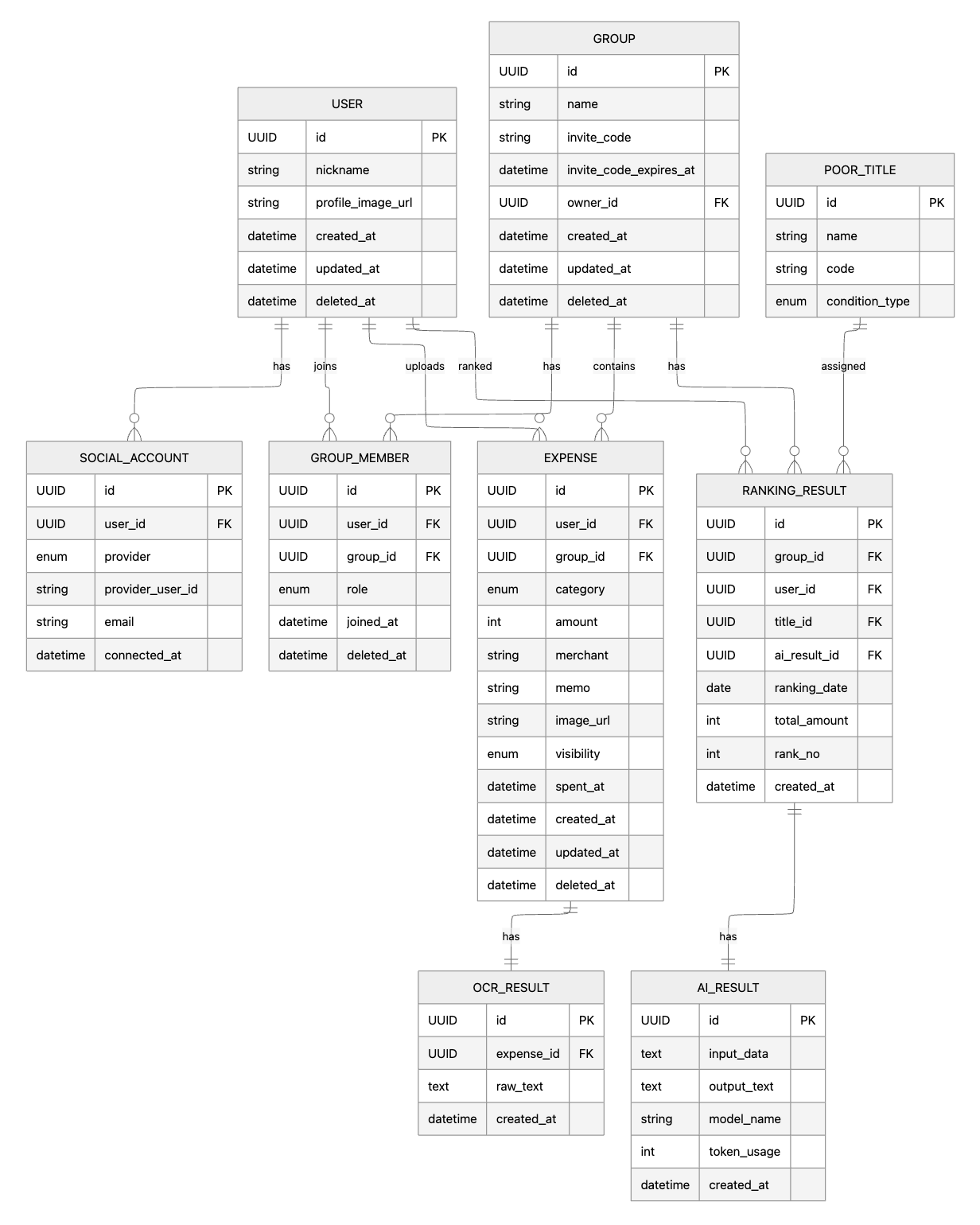
In the initial design, we focused on quickly reflecting the functionality, but today we re-examined whether each table and field is really necessary, whether there is duplicate data, and whether the design was excessive at the MVP stage.
- Reflection of PRD-based ERD feedback and final design
- Separate OCR result table
Initially,
ocr_raw_textis stored together in theEXPENSEtable.- problem
OCR results are closer to the results of analysis to create consumption details, rather than the consumption details themselves.
The original OCR text may be long, and there is a possibility that OCR accuracy or analysis results may be managed separately in the future.
- Solved: So separate table
OCR_RESULT- With this separation,
EXPENSEfocuses on confirmed consumption data, andOCR_RESULTis responsible for analysis results, making their roles clearer.
- With this separation,
- Remove AI prompt table
Initially, the
AI_PROMPT_TEMPLATEtable was added considering AI functions.Prompt type, system prompt, user prompt template, etc. were managed in the DB.
Problem
However, after reviewing it again, we found that the following features are not available in the current MVP.Modify prompt in admin page
Prompt versioning
A/B testing
Change prompts without deployment during operation
In other words, the reason for managing prompts in DB is not yet clear.
- Resolution: Prompts will be managed inside the backend code, and only the results generated by AI will be stored in the DB.
- Ultimately, the
AI_PROMPT_TEMPLATEtable is removed and onlyAI_RESULTis kept.- Remove title_text from RANKING_RESULT
- Ultimately, the
Initially, the field
title_textis placed inRANKING_RESULT.- problem
However,
RANKING_RESULTalready referencesPOOR_TITLEthroughtitle_id, so the title name can be imported asPOOR_TITLE.name.If
title_textis saved separately, the same title information is saved in two places.
- Solved: So
title_textis removed, andRANKING_RESULT.title_idrefers to the name ofPOOR_TITLE.
- Changed AI result reference structure
Initially, we try to store
roast_messagedirectly inRANKING_RESULTas a string.- problem
- However, since the vitriolic phrase is a result generated by AI, it was judged more appropriate to separate the ranking results from the AI results.
- Solved: So
RANKING_RESULTis modified to refer toAI_RESULT.
- Add invite code expiration date
- problem
- Considering the group invitation function, it was not deemed appropriate for the invitation code to be maintained indefinitely.
- Solved: Add invitation code expiration date to
GROUPtable.- This field allows you to disable expired invitation codes.
- problem
- Separate OCR result table
- Final ERD
ERD Mermaid Code
1
2
3
4
5
6
7
8
9
10
11
12
13
14
15
16
17
18
19
20
21
22
23
24
25
26
27
28
29
30
31
32
33
34
35
36
37
38
39
40
41
42
43
44
45
46
47
48
49
50
51
52
53
54
55
56
57
58
59
60
61
62
63
64
65
66
67
68
69
70
71
72
73
74
75
76
77
78
79
80
81
82
83
84
85
86
87
88
89
90
91
92
93
94
95
96
97
98
99
100
101
102
103
104
105
106
  ```mermaid
  erDiagram
      USER ||--o{ SOCIAL_ACCOUNT : has
      USER ||--o{ GROUP_MEMBER : joins
      GROUP ||--o{ GROUP_MEMBER : has

      USER ||--o{ EXPENSE : uploads
      GROUP ||--o{ EXPENSE : contains

      EXPENSE ||--|| OCR_RESULT : has

      GROUP ||--o{ RANKING_RESULT : has
      USER ||--o{ RANKING_RESULT : ranked
      POOR_TITLE ||--o{ RANKING_RESULT : assigned

      RANKING_RESULT ||--|| AI_RESULT : has

      USER {
          UUID id PK
          string nickname
          string profile_image_url
          datetime created_at
          datetime updated_at
          datetime deleted_at
      }

      SOCIAL_ACCOUNT {
          UUID id PK
          UUID user_id FK
          enum provider
          string provider_user_id
          string email
          datetime connected_at
      }

      GROUP {
          UUID id PK
          string name
          string invite_code
          datetime invite_code_expires_at
          UUID owner_id FK
          datetime created_at
          datetime updated_at
          datetime deleted_at
      }

      GROUP_MEMBER {
          UUID id PK
          UUID user_id FK
          UUID group_id FK
          enum role
          datetime joined_at
          datetime deleted_at
      }

      EXPENSE {
          UUID id PK
          UUID user_id FK
          UUID group_id FK
          enum category
          int amount
          string merchant
          string memo
          string image_url
          enum visibility
          datetime spent_at
          datetime created_at
          datetime updated_at
          datetime deleted_at
      }

      OCR_RESULT {
          UUID id PK
          UUID expense_id FK
          text raw_text
          datetime created_at
      }

      RANKING_RESULT {
          UUID id PK
          UUID group_id FK
          UUID user_id FK
          UUID title_id FK
          UUID ai_result_id FK
          date ranking_date
          int total_amount
          int rank_no
          datetime created_at
      }

      POOR_TITLE {
          UUID id PK
          string name
          string code
          enum condition_type
      }

      AI_RESULT {
          UUID id PK
          text input_data
          text output_text
          string model_name
          int token_usage
          datetime created_at
      }
  ```
What to do next
Writing API specifications
Design of common parts of the project
Common Response
Error handling- Code/commit convention