[TIL] ERD design between scalability and MVP
ERD design considerations for table separation, personal information processing, AI/OCR data storage, and design criteria balancing scalability and MVP scope
한국어 원문은 여기에서 볼 수 있습니다.
What I did today
ERD Initiative
BE planning meeting
ERD confirmed
Creation of GitHub organization
Create BE repo
Request ERD feedback
Determine your technology stack
Project basic settings
- Folder structure
Meeting
ERD drafting through AI
Compare the draft with the service features of the PRD plan
- Is the POOR_TITLE table necessary?
Initially, we will try to store the title name in string form directly in the
RANKING_RESULTtable.- problem
String duplication occurs
Difficult to manage title standards/extensions
The roles between code and DB become ambiguous.
- Resolution: Separate the title into a separate
POOR_TITLEtable and refer to title_id inRANKING_RESULT
Privacy - How to handle hiding
Wondering where and how to hide it
At first, I thought I could simply make it “invisible” on the front desk.
- problem
Actual data exists in the API response.
Can be checked in developer tools or network tab
No real security/privacy processing
Resolution: An enum field indicating the public scope was added to the
EXPENSEtable.visibility_type
1
2
3
4
5
  PUBLIC
  AMOUNT_ONLY
  CATEGORY_ONLY
  HIDE_MERCHANT
  PRIVATE
Do I need a category table or not?
Initially, we wanted to separate the categories into separate tables.
- problem
Category types do not change frequently
Use only specified values
Strong data for inquiry purposes
Resolution: Ultimately, the category was decided to be managed as an enum in the
EXPENSEtable.category
1
2
3
4
5
  CAFE
  DELIVERY
  SHOPPING
  FOOD
  ...
- Is the POOR_TITLE table necessary?
What is a template? - The word “template” keeps appearing during AI function design.
1 2 3 4 5 6
- Initially, it was for storing vitriolic phrases? A collection of random sentences? AI prompt? The role was not clear, etc. - solved - During the meeting, it was summarized that what is needed in the current service is the ability for AI to generate opinion-style results. - In other words, the key is “save the sentence template” rather than the `AI 입력 → 결과 생성 흐름` itself- How should I design the AI partial table?
- At first, I simply thought about “using AI,” but as I tried to design the actual back-end structure, the following concerns arose.
Should AI prompts also be managed through DB?
How long should the AI call results be stored?
- Initially, considering relative scalability, the following structure was considered:
AI_PROMPT_TEMPLATE / AI_RESULT / AI_GENERATION_LOG
In particular, the
AI_PROMPT_TEMPLATEtable was designed to take into account prompt modification, prompt version management, experimentation with various styles, and word changes during operation.
- At first, I simply thought about “using AI,” but as I tried to design the actual back-end structure, the following concerns arose.
- How should I design the AI partial table?
Final ERD Draft
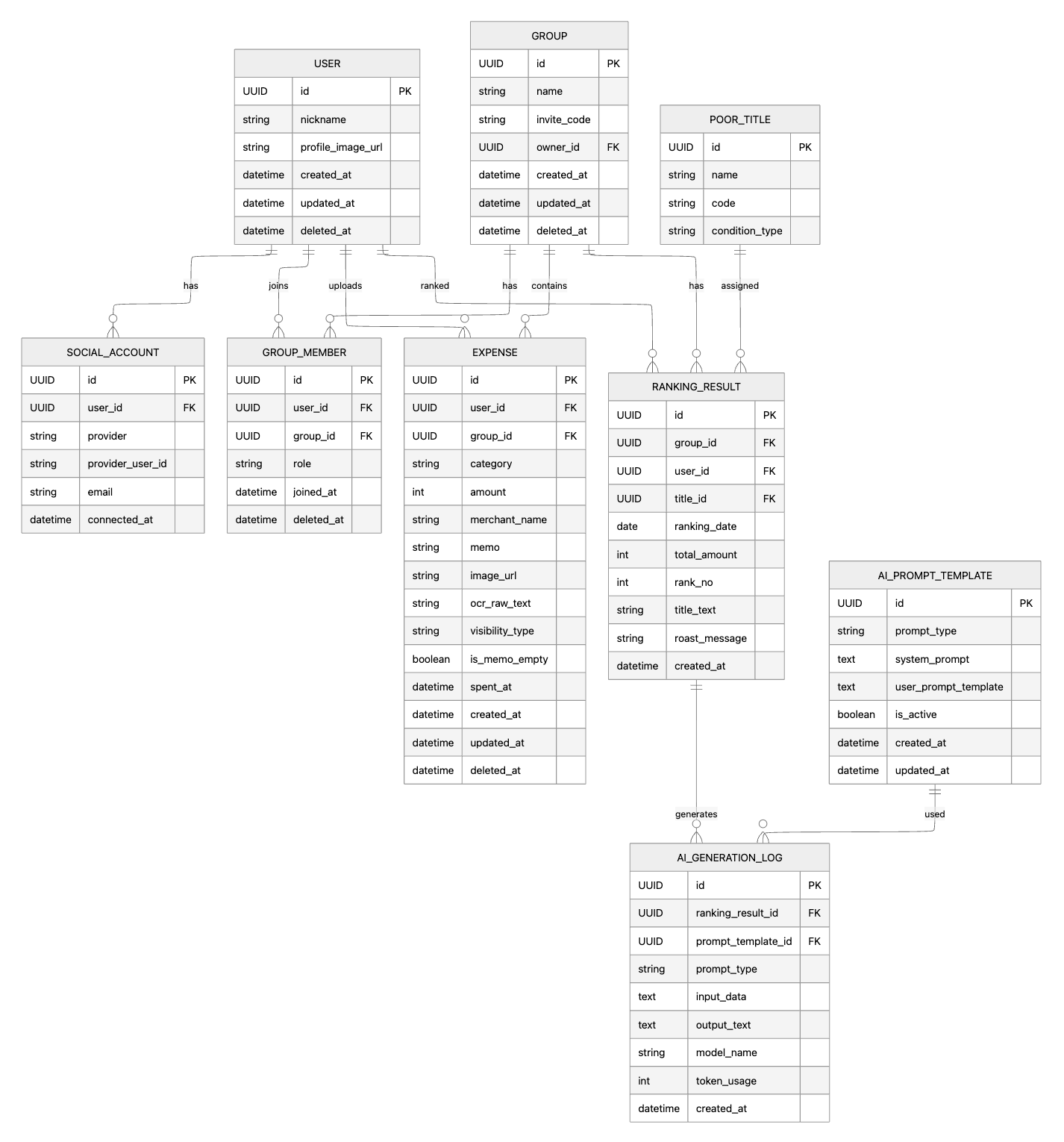
Needs modification compared to front wireframe
Need to reflect feedback
Determination of technology stack and project basic settings
Rather than simply choosing a “popular technology,” it was a process of considering which technology would be most appropriate based on the current project size, team skill level, and MVP scope.- Determination of OCR method
One of the core functions of the service is the ability to extract consumption data through OCR analysis after uploading consumption history images.
Initially, we also considered analyzing the image itself by using GPT (OpenAI API) to extract the amount/affiliate/category by sending the receipt image to GPT.
- problem
- Unnecessary increase in token usage: GPT-based image analysis uses significantly more tokens than regular OCR.- The separation of roles is ambiguous: the purpose of OCR is accurate text extraction, while GPT is stronger at inference and generation.
OCR → Text Recognition
GPT → Generative AI role
It was judged more appropriate to separate the roles into
- Unnecessary increase in token usage: GPT-based image analysis uses significantly more tokens than regular OCR.- The separation of roles is ambiguous: the purpose of OCR is accurate text extraction, while GPT is stronger at inference and generation.
- Resolution: In the end, it was decided to use an external OCR service such as Google OCR API for OCR.
- Image storage method and whether to use S3
When a user uploads a consumption history image, the image needs to be temporarily saved or forwarded for OCR processing.
However, in our service, we believe that the original image itself does not need to remain as core data after the OCR analysis is completed.
The data actually needed by the service is not images, but consumption information extracted through OCR.
Resolution: The image will not be stored permanently, but will only be used temporarily during OCR processing.
- Only the following data is stored in the DB, not the original image.
- OCR result text / consumption amount confirmed by user / affiliated store / category / memo / consumption time
This reduces unnecessary image storage space and eliminates the need to store receipt images that may contain personal information for a long time.
- Currently, MVP has decided not to introduce external image storage such as S3 first.
Images are not required after OCR processing
No need for large image storage
Increased infrastructure complexity due to S3 integration
Reduces the burden of storing images that may contain personal information
In other words, we decided to use images only as “input values for OCR processing” rather than as “data that needs to be stored.”
- Only the following data is stored in the DB, not the original image.
- Selection of DB and backend technology
- Why we also considered Supabase
- Fast MVP development possible / Convenient integration with front-end / Many cases of combination with Flutter / Advantages such as provision of authentication/DB functions- problem
However, the backend team members had more Spring Boot + JPA experience.
Also, this project is not just about creating a service:
- It was also an important goal to directly implement and experience backend structure design / API design / ERD design / service hierarchy / JPA relationship, etc.
In other words, it was judged that “designing and experiencing the back-end structure directly” was more important than rapid development.
Solved:
Finally decided on the following combination- Backend: Spring Boot 3.x, Java 17, Gradle
- Spring Boot: Most familiar to team members / Easy to apply layered architecture / Able to utilize JPA / Experience in designing maintenance structures
- DB: MySQL, Spring Data JPA
- MySQL: Stable integration with Spring/JPA / Suitable for relational data modeling / Well suited to ERD-based design
- Backend: Spring Boot 3.x, Java 17, Gradle
- Fast MVP development possible / Convenient integration with front-end / Many cases of combination with Flutter / Advantages such as provision of authentication/DB functions- problem
- Why we also considered Supabase
- Determination of OCR method
Lessons learned
The biggest thing I felt through this meeting was that a good design is not necessarily a complicated design.
At first, we thought about maximizing scalability by separating categories into separate tables, adding AI prompt tables, and managing booleans for notes or not, but as we discussed it, we felt that it was more important to make decisions based on
“지금 실제로 필요한 기능인가?”at the MVP stage.I also learned that we need to think not only about functional implementation, but also about data duplication, separation of responsibilities, roles of front and back end, and balance between scalability and current complexity.
I was particularly impressed by
“숨기는 것”과 “실제로 접근을 제한하는 것”은 다르다in terms of privacy processing. I learned that it is not just simple UI processing, but also the need to consider what form the data will be sent from the backend.- I also feltAI를 사용한다고 해서 모든 것을 AI 전용 테이블로 관리할 필요는 없다in the AI design part. Choosing an appropriate structure for the current service phase was more important than a technically feasible structure.Through this meeting, I was able to learn that a design that can explain
왜 이런 구조를 선택했는가is more important than simply “implementing functions.”
What to do next
Reflection and correction of ERD feedback
Writing API specifications
Design of common parts of the project
Common Response
Error handling
Code/commit convention