[TIL] Refining the ERD around the user flow
ERD structure modification based on user flow, data responsibility separation, and AI/OCR result management methods
한국어 원문은 여기에서 볼 수 있습니다.
What I did today
- Write the final plan
Reflection of feedback from management
Reflection of our team’s thoughts on feedback
- Summary of ERD modifications
Reflection of feedback
Comparison with wireframe
- Reflection of ERD modifications
Edit ERD
Service direction and ERD structure were reorganized based on the first planning feedback of the TodayPoor project.
1st revision
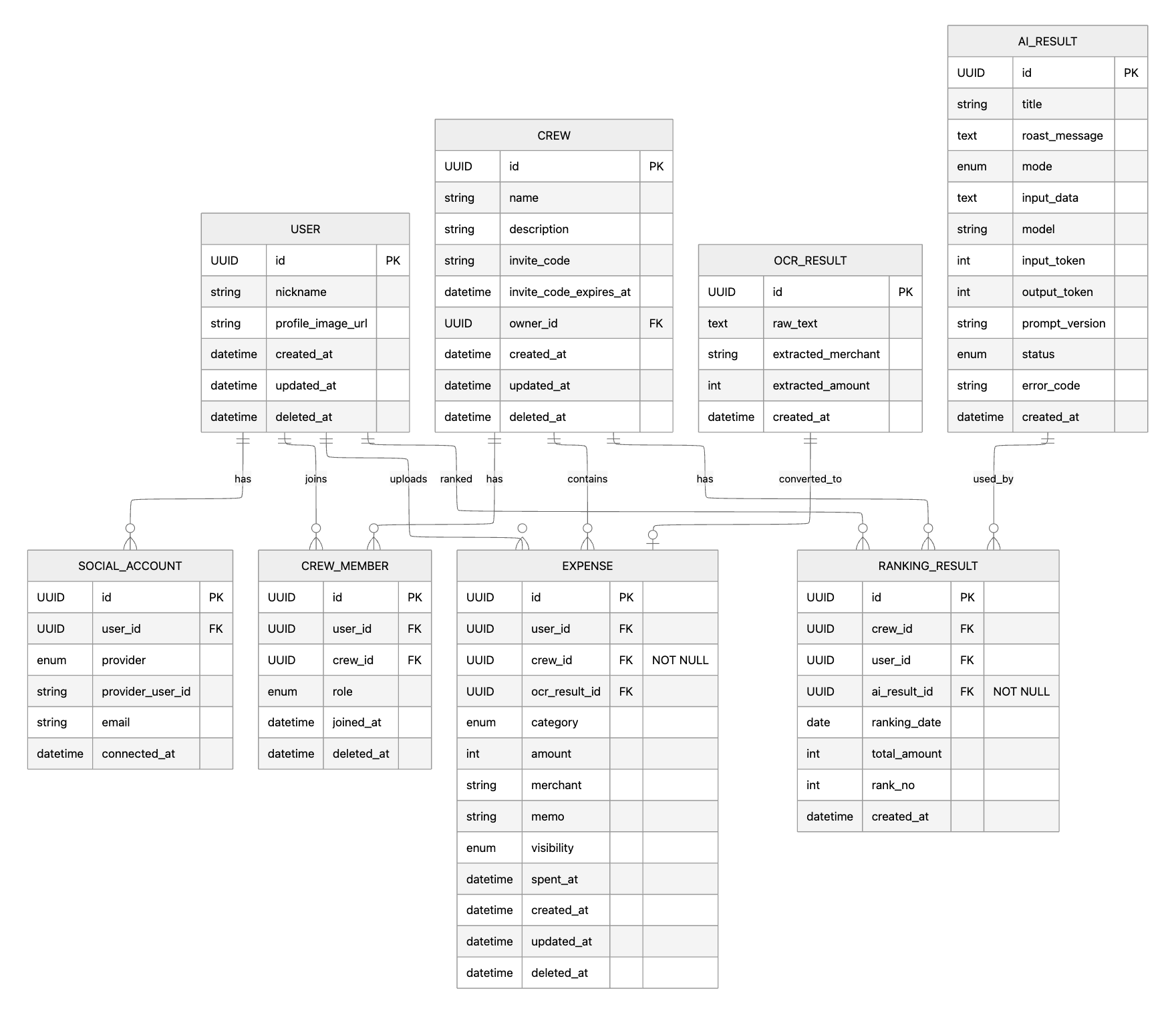
Change Items Existing structure Change structure Reason for change Change group terminology GROUP, GROUP_MEMBER CREW, CREW_MEMBER Since the term “crew” is used in the front wireframe, the FE/BE/plan terminology was changed to unify it. Change group FK name group_id crew_id Since the table name was changed to CREW, the FK name was also modified to be consistent. Add crew description doesn’t exist Add CREW.description A description text is needed on the crew card in the wireframe, so add it to store crew introduction/description information. Remove POOR_TITLE POOR_TITLE table exists delete table A separate title table becomes unnecessary because the title is not managed as a fixed value but is generated by AI each time. Add AI result fields AI_RESULT.output_text centered Add title, roast_message, mode AI generates award titles and vitriol/feedback phrases together, so they are added to separate and save the results Change AI model name field name model_name model Changed field names to make them more concise Token Usage Separation token_usage input_token, output_token Changed to more accurately record AI usage by separating input and output tokens Add prompt version doesn’t exist Add prompt_version Added to keep track of which version of the prompt resulted in the result, even if the prompt is managed in code. Add AI call status doesn’t exist Add status Added to store AI call success/failure Add AI error code doesn’t exist Add error_code Added to track and debug the cause when AI call fails Change OCR relationship OCR_RESULT.expense_id EXPENSE.ocr_result_id The OCR results are generated first, and the final consumption data modified/confirmed by the user is stored in EXPENSE, so EXPENSE is changed to refer to the OCR results. Add OCR extracted value Save only OCR_RESULT.raw_text Add extracted_merchant, extracted_amount Added to allow comparison between the merchant/amount initially recognized by OCR and the final value modified by the user Remove image URL EXPENSE.image_url delete After OCR recognition, the original image is no longer needed, so it is removed to avoid saving it to the DB. Consumer-crew relationship becomes essential crew_id is nullable EXPENSE.crew_id NOT NULL It is set as a required value because the policy is that users must register consumption records while joining the crew. Mandatory ranking-AI result relationship ai_result_id is nullable RANKING_RESULT.ai_result_id NOT NULL Crew members’ MVP rankings are set to NOT NULL because they necessarily include AI results. Clarification of ranking cycle Only ranking_date exists Use ranking_date on a daily basis Since the service provides MVP/ranking on a daily basis, ranking date is managed on a daily basis. In this ERD revision, the front wireframe terminology and backend domain name are aligned, and
POOR_TITLEis removed to match the structure in which AI generates titles and feedback.In addition, the relationship between
OCR_RESULTandEXPENSEwas reorganized to separate the OCR initial recognition result and the final consumption data modified by the user.Through this, we improved the data structure to be more suitable for MVP service flow.
2nd revision
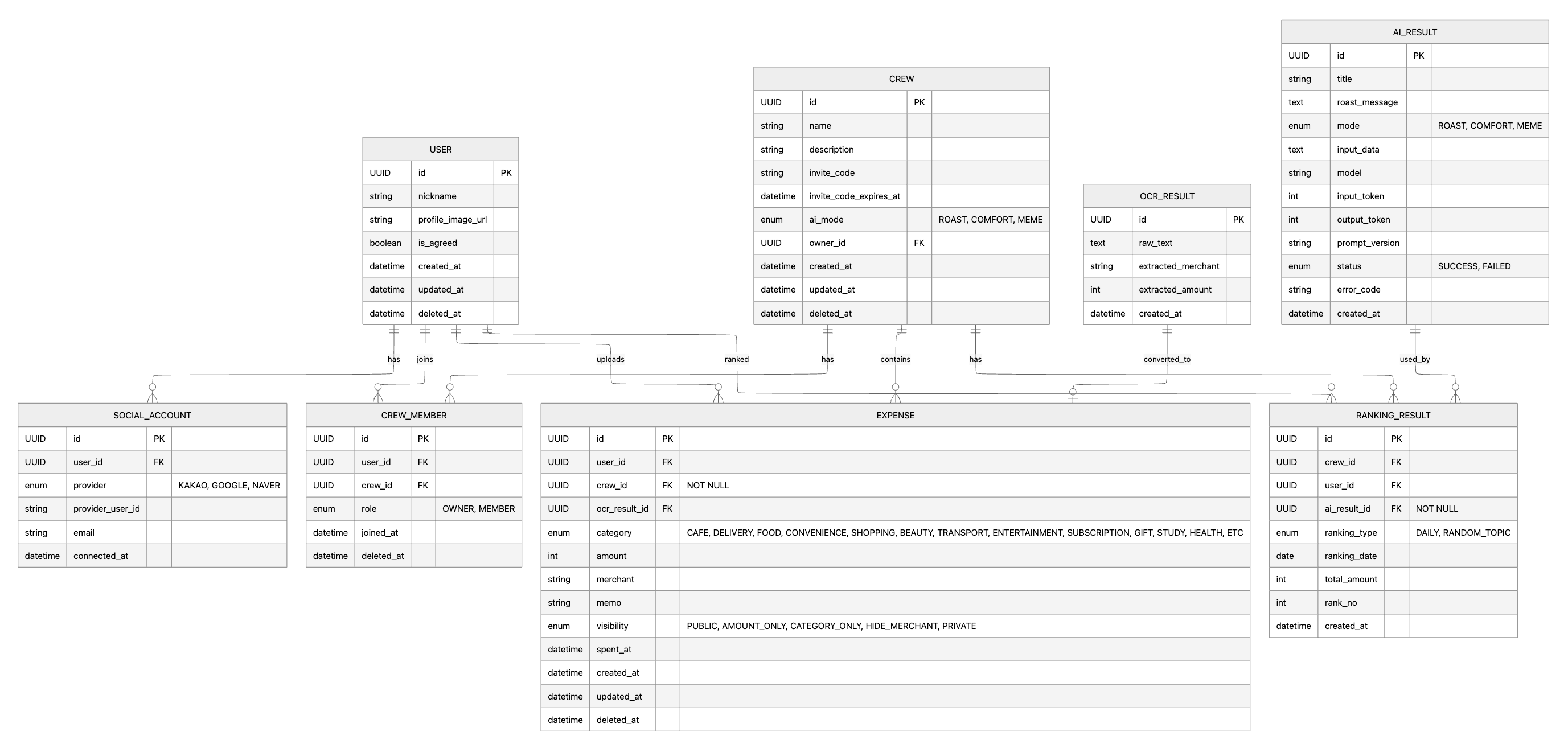
Change Items Existing structure Change structure Reason for change Add ranking type There is no ranking type distinction in RANKING_RESULT Add ranking_type Added to distinguish between date-based ranking results and random topic-based ranking results Ranking type enum definition doesn’t exist DAILY, RANDOM_TOPIC Front wireframe shows both daily and random topic results to clearly distinguish between result types Add consent to member information No consent to USER Add is_agreeed Added to store personal information and consent regarding service use when registering as a member Add AI mode for each crew AI mode exists only in result table Add CREW.ai_mode Added to allow setting AI feedback mood/intensity for each crew Stay in AI Results Mode AI_RESULT.mode exists stay the same Maintain a record of what mode the AI results were created in Specify enum value Displays only the type like enum provider and enum visibility Specify enum candidate values as strings in Mermaid Added to help you understand which enum values are used just by looking at the ERD - additionally
- At first, since the AI mode is set at the CREW level, I was wondering whether AI_RESULT should also refer to CREW’s ai_mode like FK.
However, the roles of the two values were different.
CREW.ai_mode is the ‘AI mode value currently set by the crew’,
AI_RESULT.mode is ‘the mode value actually used when the AI result was generated’
→ In other words, the crew’s ai_mode may be changed later, but already generated AI results must remain in whatever mode they were created at the time of creation.
- Therefore, rather than AI_RESULT directly referencing (FK) CREW.ai_mode, it was judged more appropriate to store the mode value used when generating AI results in AI_RESULT.
- At first, since the AI mode is set at the CREW level, I was wondering whether AI_RESULT should also refer to CREW’s ai_mode like FK.
- additionally
Lessons learned
We found that a proper ERD can be created by not only drawing tables, but also considering actual user flow, FE screen structure, data responsibility, AI result management, operation and debugging, and future expansion possibilities.- At first, it seemed like the more tables you created, the better, but I felt that a clear structure with clear responsibility and flow of data was more important.
Based on what we discussed today, we will have to think about connecting API design and actual service flow in the future.