[TIL] Special lecture on MSA data consistency
Distributed transaction and data consistency issues in MSA, Saga pattern, compensation transactions, and Outbox pattern concepts
한국어 원문은 여기에서 볼 수 있습니다.
What I Learned
1. Complexity of distributed transactions
(1) Transactions in monolithic vs. problems in microservices
In Multiple Microservices, for example, Order, Invoice, Payment, Shipping, etc. are composed of different services and DBs and collaborate.
- For monolithic applications
Since only one database is accessed, transactions can be easily managed using declarative transactions (@Transactional, etc.) provided by frameworks such as Spring.
All data is in one place, so commit/rollback logic is simple.
- In case of microservice environment
Since each service uses a separate DB or message broker, multiple services are linked to one business logic.
Applying traditional distributed transactions (2PC, etc.) is subject to several limitations.
- Latest technologies such as many NoSQL DBs, Kafka, and RabbitMQ do not support 2PC transactions such as XA.
(2) 2PC/XA protocol limit
- Traditional distributed transaction using XA protocol (2PC)
In theory, it is possible to commit/rollback multiple resources simultaneously, but the latest NoSQL message brokers often do not support it, and it is difficult to apply in heterogeneous environments.
All participating nodes must be ‘always available’, which reduces the overall availability of the system.
→ As a result, it is difficult to easily process distributed transactions in a microservice environment, and alternative approaches such as Saga pattern have become widely used.
2. Concept and necessity of Sage pattern
(1) Why Saga is the solution?
- Alternative to distributed transactions
- In a microservice environment where traditional 2PC is difficult to apply, each service is responsible only for local transactions, and controls the entire flow through events or orchestrator when each step succeeds/failures.
- Local transaction + compensation transaction
- If a failure occurs at the point where one step is committed and then moved to the next step, consistency is adjusted with logic to ‘revert (compensate)’ already committed work.
(2) How Saga works: step-by-step local transactions and compensating transactions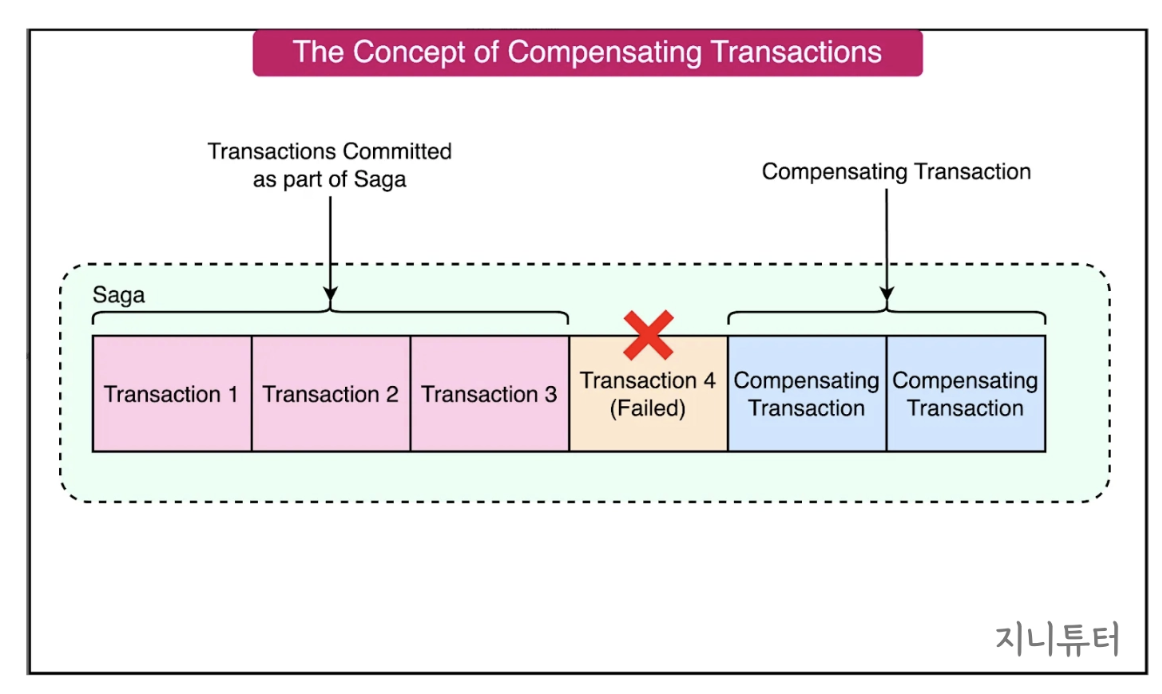
Figure showing that if a failure occurs at a certain stage (T4), the already completed tasks of T1, T2, and T3 must be undone in reverse order.
Example) In the e-commerce ordering process, inventory decreases → If the final authorization (Authorize) fails at the end of payment, a compensation transaction to “restore inventory” is performed.
(3) Example of e-commerce order, differences from ACID (isolation issue)
Placing an Order → Creating an Invoice → Payment → Shipping
In monolithic, transactions were easily processed in one DB, but when separated into microservices, multiple DB/service linkages are required.
Traditional ACID transactions guarantee ‘Isolation’, but in Saga, each step is committed, so intermediate states can be exposed to the outside.
3. Orchestration-based Saga
(1) Centralized Orchestrator and Command/Reply
In Orchestration-based Saga, there is a central Orchestrator that directs the order (flow) of all local transactions. The orchestrator sends Command messages such as “Pay now” or “Send delivery now” to each service, and the service returns a Reply event after completing the task.
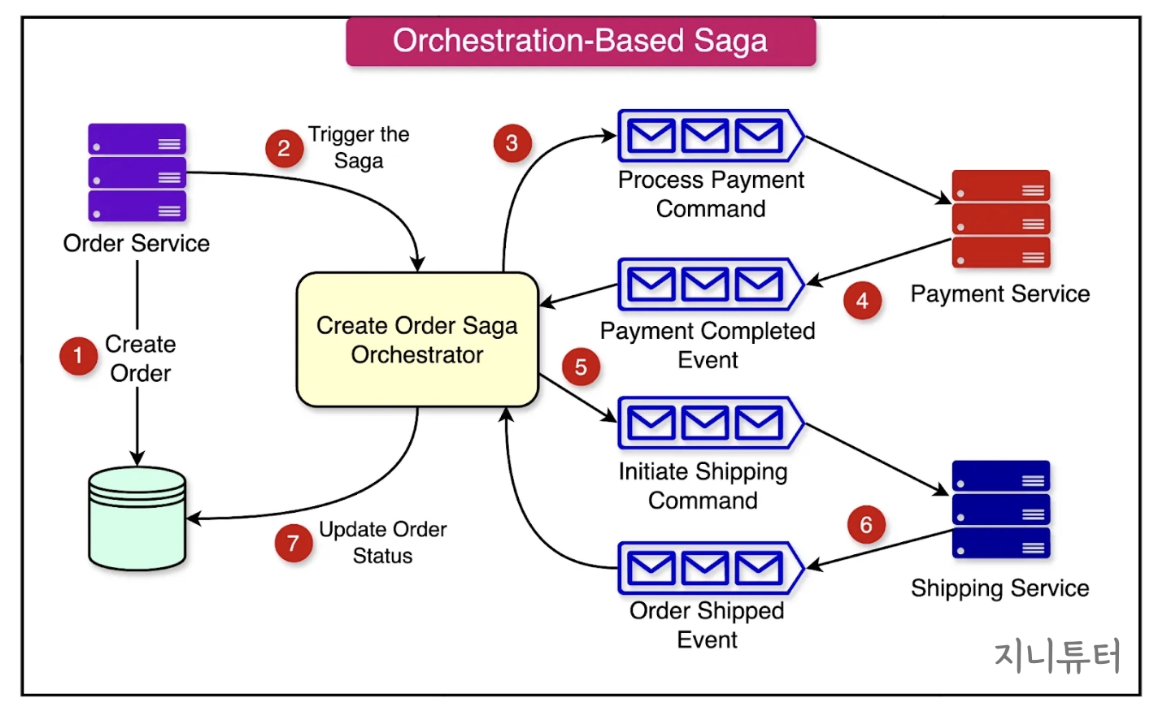
When an order (Order Service) is created (1), the central Saga orchestrator accepts it and instructs “payment processing” (3)
When you receive the payment completion event (4), instruct “delivery” (5)
Final update of order status after confirming delivery completion (6) (7)
If an error occurs along the way, the orchestrator triggers a compensation transaction to revert what has already been committed.
(2) Orchestration-based advantages and disadvantages
- Advantages
- Simpler Dependencies
- All flows are managed by Orchestrator → No circular dependency
- Loose Coupling
- Since each service only needs to respond to commands given by the Orchestrator, direct calls between services are reduced.3. Strengthen separation of concerns
- Entire business logic (flow control) is gathered in Orchestrator, and each service focuses on local transactions
- Simpler Dependencies
- Disadvantages
- Centralization of business logic
If excessive logic is placed on the Orchestrator, there is a risk that it will become an “overly smart” central system and each service will become simple.
Since it can be a single point of failure (SPoF), HA (High Availability) configuration must be considered.
Since the Orchestrator directs the entire process, even if the service is fine, if the Orchestrator dies, order processing will not even start.
HA → High availability, a structure that allows another child to take over even if one dies.
- For example, instead of having just one Orchestrator, have several.
- Performance Issue
- Since all requests go through the Orchestrator, latency is added, and throughput limits depend on Orchestrator performance.
Since it goes through one more time like
주문 서비스 → Orchestrator → 결제 서비스, in the middle case, time is added and latency increases.If a lot of requests come in, a single orchestrator coordinates them all, so processing can become a bottleneck.
- Total throughput may be tied to Orchestrator performance
- Since all requests go through the Orchestrator, latency is added, and throughput limits depend on Orchestrator performance.
- Centralization of business logic
4. Choreography-based Sage
(1) Event publication/subscription method
In Choreography-based Saga, each service publishes and subscribes to events and proceeds to the next step on its own, without an Orchestrator.
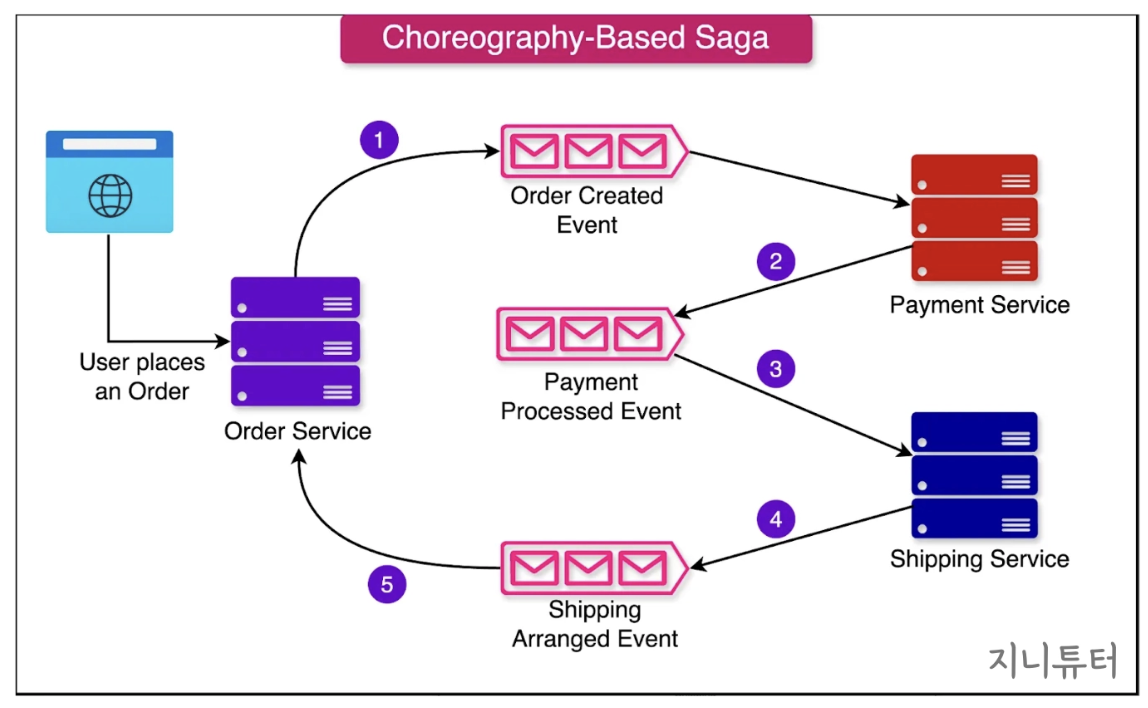
Order Service issues
OrderCreatedeventPayment Service subscribes to this and proceeds with payment. If successful,
PaymentSucceededevent is issued.Shipping Service subscribes again, executes delivery, and issues
ShippingArrangedevent.4. In case of payment failure, the flow is completed by issuing an order cancellation event as a compensation transaction.
(2) OutBox pattern & event
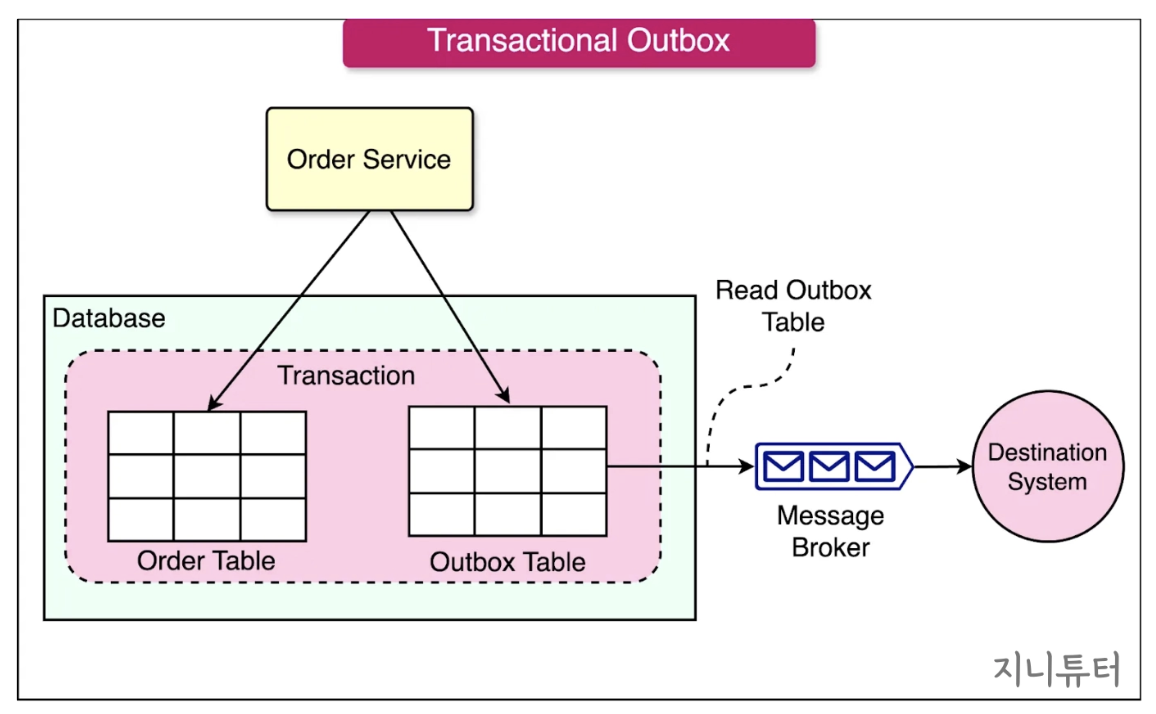
Atomic (Atomic) Guarantee: Outbox table technique can be used to bundle “DB change” and “event issue” into one local transaction.
- For example, when an order service creates an order, it must store order data in the DB and send events to a message broker such as Kafka.
The problem is that these two may succeed separately → Then, there is an order in the DB, but other services do not receive the ‘order created’ event, so they do not know that an order has been created, and the delivery service may not create the delivery.
The opposite is also possible (Kafka event issuance success, DB storage failure) → There is no order in the actual DB, but other services may mistakenly believe that an order has been created.
- So use the OutBox table
Event publication schedule table
Rather than sending the event directly to Kafka, I first store the event record in my DB.
→ In other words, order storage and event storage are processed together in the DB.
- Kafka issuance is
- Later, a separate process reads the outbox table and issues an event to Kafka → if successful, changes the outbox status to SENT (from PENDING)
Issue 2: When the database does not support transactions, such as NoSQL DBThe core of the Transaction Outbox pattern is to ensure atomicity and single transaction of the entity table and outbox table.
There may be cases where the ordering service cannot support transactions using NoSQL DB.
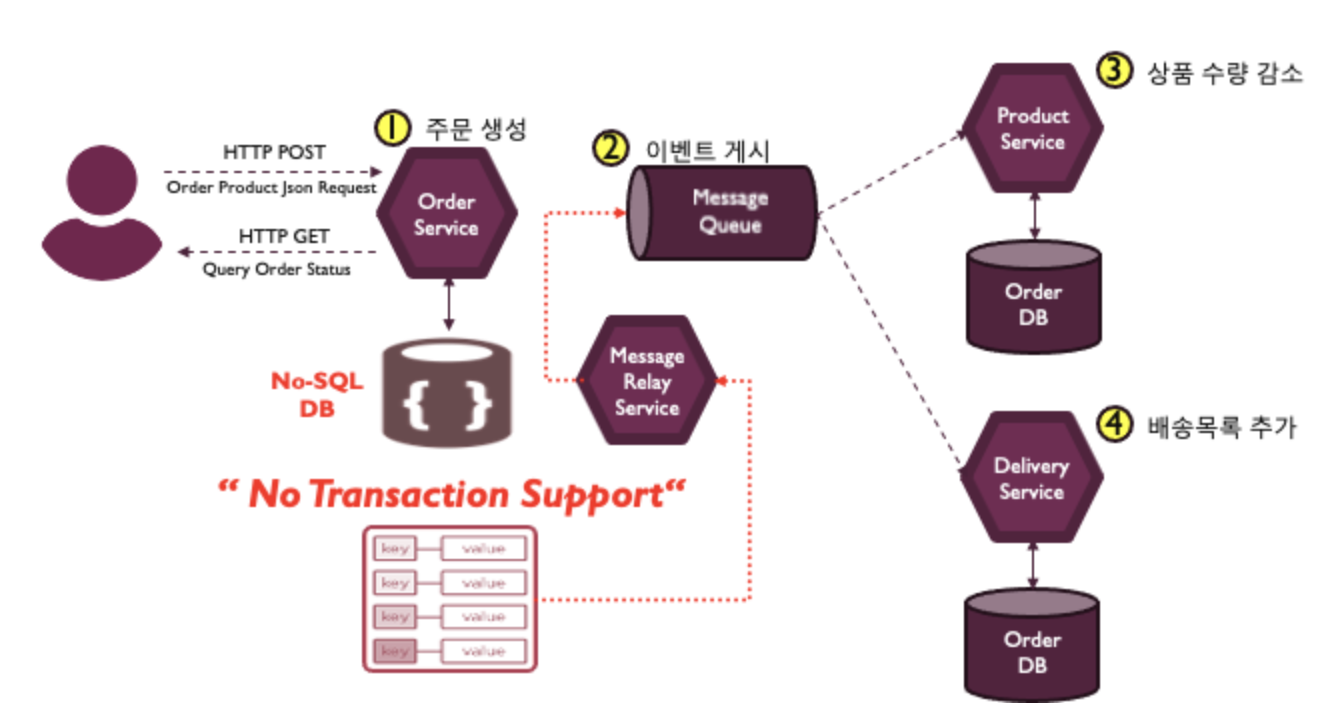 In this case, you can add a property containing the message content to the object containing the order information and send the message to the message broker.
Adding event information to be issued to a NoSQL DB can also be said to be atomic.
1
2
3
4
5
6
7
8
9
10
11
12
13
14
  {
  order_id: "20231108019",
  buyer: {
  id: 10003,
  email: "abcd@sk.com",
  address: "SK U Tower"
  },
  item: {
  id: 13035,
  name: "Wireless Keyboard",
  quantity: 1
  },
  <span style="color: #ff0000">outbox: [...]</span>
  }
The message relay service periodically queries records in the database to find outbox properties and delivers them to the message broker.
You can use the transactional outbox pattern even if you use a NoSQL DB that does not support transactions by deleting the Outbox attribute in the record at the end.
- For example, when an order service creates an order, it must store order data in the DB and send events to a message broker such as Kafka.
Correlation IDs: Events include common identifiers such as
orderId, allowing other services to determine which transaction/order the event is associated with.Common identifier for tracking purposes
Used to check whether events occurring between services come from the same order.
For example, in order flow, orderId can be used as Correlation Id.
Issue 1: Duplication of events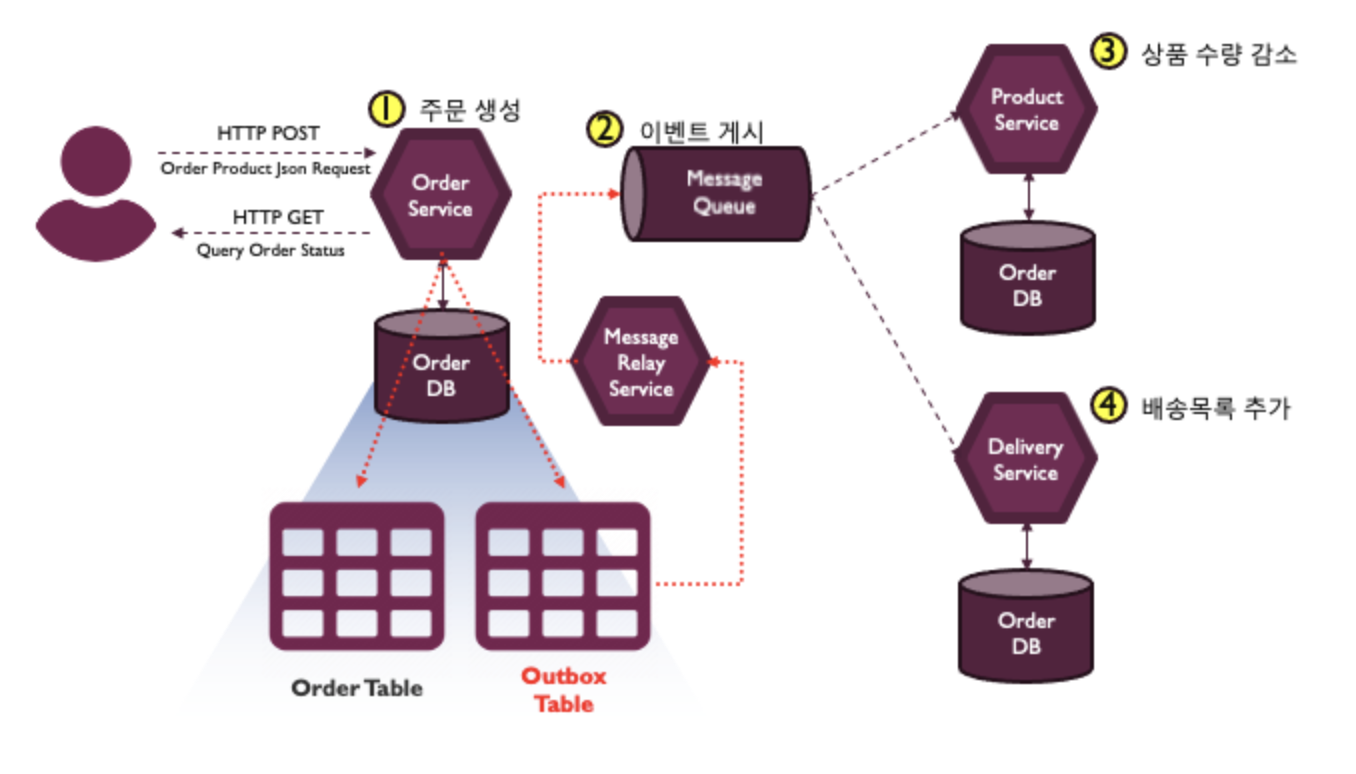
If an error occurs while the message relay service reads message data from the Outbox table and delivers it to the message broker,
If an instance of another message relay service delivers the Outbox table back to the message broker, a situation may arise where the same message is delivered twice.
A problem occurs that slows down product quantity twice and creates two delivery lists.
→ This problem can be solved by developing product services and delivery services to ensure idempotence. (The result remains the same even if the same request is sent multiple times)When the Outbox table stores message information, an ID value is assigned to each message, and when the message relay service assigns the corresponding ID value to an event that occurs as a message broker,
The product or delivery service that received the message can compare this ID value to know that it is an already processed event or a duplicate event and ignore it.
Issue 3: Message orderIf a user cancels a product immediately after ordering it, the message relay service periodically monitors the outbox table and finds two messages: order creation and order cancellation.
Without understanding the order of business, the order cancellation event may be issued before the order creation event.
In this case, the delivery service must receive an order cancellation event and delete the already added delivery information, but since there is no information, it is ignored. If an order event is received and delivery information is created later,
Although the order has been cancelled, problems may still occur in the delivery list.
This problem can be solved by assigning a sequential ID to each message in the outbox table, and sorting by ID when issuing events to ensure order.
(3) Choreography Advantages/Disadvantages
- Advantages
- No single point of failure (SPOF)
- There is no central orchestrator, so one point of failure does not stop the whole thing.
- Scalability
- Even if event-based services increase, it is relatively easy to add new features by simply adding a subscription.
- No single point of failure (SPOF)
- Disadvantages
- Event flow distribution
- The entire business logic is divided into multiple service events, increasing the difficulty of debugging/management.
- Event sequence, overlap, cycle
- Ensure order, logic to avoid processing the same event multiple times, circular references, etc. must be carefully designed.### 5. Orchestration vs. Choreography: Comparison from Saga Perspective
- Event flow distribution
1
2
3
4
5
6
7
8
9
10
11
[오케스트레이션 기반 Saga]

1) 순서 제어 및 보상 트랜잭션을 중앙 Orchestrator가 담당
2) 서비스 간 결합도 낮음, 전체 흐름 한눈에 파악 쉬움
3) 단일 장애점(SPoF), Orchestrator 로직 과부하 위험

[코레오그래피 기반 Saga]

1) 이벤트 발행/구독으로 상호작용
2) 중앙 집중 구성이 없어 장애 전파 위험 감소, 유연성 높음
3) 이벤트 흐름이 복잡해지면 관리/디버깅 어려움
Both methods are representative techniques for implementing the Saga pattern in a microservice environment, and can be appropriately selected or mixed depending on organizational culture or system scale.
6. Orchestration vs. Choreography: Application across microservice collaboration models
Beyond Saga, an overall comparison of two approaches, Orchestration and Choreography, when microservices collaborate (including general inter-service collaboration patterns in addition to microservice transactions)
(1) General overview
- Orchestration
Central Orchestrator mediates all calls and responses
Service coupling is low and the domain boundary is clear, so the test scope is clear.
- Choreography
Point-to-point communication where each service exchanges messages directly
Service dependencies are intertwined and complex, and failover scenarios can be difficult.
(2) Real-life examples such as Netflix Conductor
- Netflix Conductor:
Microservice orchestration tool released as open source by Netflix
Centrally define/control the execution flow (workflow) of multiple microservices
In addition, there are various Orchestrator tools such as Camunda, Zeebe, and AWS Step Functions, and each has differences in performance/operability/failure response methods.
Example source code
Sample code to simply demonstrate Orchestration-based SAGA pattern with Spring Boot + Kafka.
To configure MSA (microservice) in an actual operating environment, each service (order, payment, delivery, etc.) must be separated into separate project or separate application, and DB, repository, configuration files, etc. must be divided separately.
Here we’ll simply mock it up inside one Spring Boot application, just to give you a taste of what the SAGA (orchestration) flow and code structure looks like.<div class="notion-indent" markdown="1">
Execution flow summary
User calls POST /orders?productName=AAA&quantity=2&price=10000
OrderService: Save Order (status = PAYMENT_PENDING) in DB and issue OrderCreatedEvent(orderId, amount) → order-events topic.
(Practice) PaymentService: Subscribe to order-events → Payment attempt → Issue success/failure events (PaymentCompletedEvent, PaymentFailedEvent) to the payment-events topic.
(Sample) Here, simulatePayment(orderId) is randomly called with PaymentServiceSimulator to force an event to be issued.
1.OrderOrchestrator
Upon receiving PaymentCompletedEvent → OrderStatus = PAID → Issue a shipping request event (shipping-events)
When receiving PaymentFailedEvent → OrderStatus = PAYMENT_FAILED → CANCELLED
When receiving ShippingCompletedEvent → OrderStatus = COMPLETED
</div>
Note: The code below has been simplified as much as possible for learning purposes, and all exception handling, transactions, security, and test codes have been omitted. Please note that in practice, more elaborate design and additional settings are required.
Project Structure
1
2
3
4
5
6
7
8
9
10
11
12
13
14
15
16
17
18
19
20
21
22
23
24
25
26
27
28
29
30
└─ src
   ├─ main
   │   ├─ java
   │   │   └─ com.example.sagasample
   │   │       ├─ SagasampleApplication.java
   │   │       ├─ config
   │   │       │   ├─ KafkaConsumerConfig.java
   │   │       │   └─ KafkaProducerConfig.java
   │   │       ├─ controller
   │   │       │   └─ OrderController.java
   │   │       ├─ domain
   │   │       │   ├─ Order.java
   │   │       │   ├─ OrderStatus.java
   │   │       │   └─ PaymentStatus.java
   │   │       ├─ events
   │   │       │   ├─ OrderCreatedEvent.java
   │   │       │   ├─ PaymentCompletedEvent.java
   │   │       │   ├─ PaymentFailedEvent.java
   │   │       │   └─ ShippingCompletedEvent.java
   │   │       ├─ repository
   │   │       │   └─ OrderRepository.java
   │   │       ├─ service
   │   │       │   ├─ OrderOrchestrator.java
   │   │       │   ├─ OrderService.java
   │   │       │   └─ PaymentServiceSimulator.java
   │   │       └─ ...
   │   └─ resources
   │       └─ application.yml
   └─ test
       └─ ...
`application.yml`
1
2
3
4
5
6
7
8
9
10
11
12
13
14
15
16
server:
  port: 8080

spring:
  kafka:
    bootstrap-servers: localhost:9092
    consumer:
      group-id: saga-example-group
      auto-offset-reset: earliest
      key-deserializer: org.apache.kafka.common.serialization.StringDeserializer
      value-deserializer: org.springframework.kafka.support.serializer.JsonDeserializer
      properties:
        spring.json.trusted.packages: "*"
    producer:
      key-serializer: org.apache.kafka.common.serialization.StringSerializer
      value-serializer: org.springframework.kafka.support.serializer.JsonSerializer
Kafka producer/consumer setup (simple example)
In the example, Spring Boot’s automatic configuration (Spring for Apache Kafka) is utilized to its full potential, so there is not much additional configuration.Caution: In actual operation, a strategy for topic creation permissions, number of partitions, etc. is required.
1
2
3
4
5
6
7
8
9
10
11
12
13
14
15
16
17
18
19
20
21
22
23
24
25
26
27
28
29
30
31
32
33
34
35
36
37
38
39
40
41
42
43
44
package com.example.sagasample.config;

import org.apache.kafka.clients.admin.NewTopic;
import org.springframework.context.annotation.Bean;
import org.springframework.context.annotation.Configuration;

@Configuration
public class KafkaTopicConfig {

    // 필요한 토픽들을 미리 생성 (자동 생성 옵션이 꺼져 있는 환경이라면)
    @Bean
    public NewTopic orderTopic() {
        return new NewTopic("order-events", 3, (short)1);
    }

    @Bean
    public NewTopic paymentTopic() {
        return new NewTopic("payment-events", 3, (short)1);
    }

    @Bean
    public NewTopic shippingTopic() {
        return new NewTopic("shipping-events", 3, (short)1);
    }
}
package com.example.sagasample.config;

import org.springframework.context.annotation.Configuration;
import org.springframework.kafka.annotation.EnableKafka;

@EnableKafka
@Configuration
public class KafkaConsumerConfig {
    // 추가적인 Consumer 설정이 필요하다면 Bean 등록
}

package com.example.sagasample.config;

import org.springframework.context.annotation.Configuration;

@Configuration
public class KafkaProducerConfig {
    // Producer에 대한 추가 Bean 설정이 필요한 경우
}
Domain and event classes
3-1) Order domain (entity)
1
2
3
4
5
6
7
8
9
10
11
12
13
14
15
16
17
18
19
20
21
22
23
24
25
26
27
28
29
30
31
32
33
34
35
package com.example.sagasample.domain;

import javax.persistence.*;

@Entity
public class Order {

    @Id
    @GeneratedValue(strategy = GenerationType.IDENTITY)
    private Long id;

    private String productName;
    private int quantity;
    private int price;

    @Enumerated(EnumType.STRING)
    private OrderStatus orderStatus;

    public Order() { }

    public Order(String productName, int quantity, int price) {
        this.productName = productName;
        this.quantity = quantity;
        this.price = price;
        this.orderStatus = OrderStatus.CREATED;// 최초 주문 생성 시점
    }

// getter / setter ...

    public void setOrderStatus(OrderStatus status) {
        this.orderStatus = status;
    }

// 기타 편의 메소드 ...
}
1
2
3
4
5
6
7
8
9
10
11
package com.example.sagasample.domain;

public enum OrderStatus {
    CREATED,// 주문 생성됨
    PAYMENT_PENDING,// 결제 진행 중
    PAYMENT_FAILED,// 결제 실패
    PAID,// 결제 완료
    SHIPPING,// 배송 중
    COMPLETED,// 배송 완료(주문 최종 완료)
    CANCELLED// 주문 취소됨 (보상 트랜잭션)
}
3-2) Event object (Kafka message payload)
OrderCreatedEvent: Event notifying the order service -> payment service that “order has been created”
PaymentCompletedEvent / PaymentFailedEvent: Payment service -> Notify payment result to order/orchestrator
ShippingCompletedEvent: Shipping completion event (just simulated here)
1
2
3
4
5
6
7
8
9
  package com.example.sagasample.events;

  public class PaymentCompletedEvent {
      private Long orderId;
  // 결제 후 필요한 데이터public PaymentCompletedEvent() {}
      public PaymentCompletedEvent(Long orderId) {
          this.orderId = orderId;
      }
  }
1
2
3
4
5
6
7
8
9
10
11
12
  package com.example.sagasample.events;

  public class PaymentFailedEvent {
      private Long orderId;
      private String reason;

      public PaymentFailedEvent() {}
      public PaymentFailedEvent(Long orderId, String reason) {
          this.orderId = orderId;
          this.reason = reason;
      }
  }
1
2
3
4
5
6
7
8
9
10
11
  package com.example.sagasample.events;

  public class ShippingCompletedEvent {
      private Long orderId;

      public ShippingCompletedEvent() {}
      public ShippingCompletedEvent(Long orderId) {
          this.orderId = orderId;
      }
  // getter, setter
  }
Repository
1
2
3
4
5
6
7
package com.example.sagasample.repository;

import com.example.sagasample.domain.Order;
import org.springframework.data.jpa.repository.JpaRepository;

public interface OrderRepository extends JpaRepository<Order, Long> {
}
Orchestrator & Services
5-1) OrderService
When creating Order, save
Orderentity in DB, change status toPAYMENT_PENDINGand issue OrderCreatedEventLogic for receiving external results such as payment/delivery is processed in OrderOrchestrator (or processed together within the same service)
1
2
3
4
5
6
7
8
9
10
11
12
13
14
15
16
17
18
19
20
21
22
23
24
25
26
27
28
29
30
31
32
33
34
35
36
37
38
39
40
41
42
43
  ckage com.example.sagasample.service;

  import com.example.sagasample.domain.Order;
  import com.example.sagasample.domain.OrderStatus;
  import com.example.sagasample.events.OrderCreatedEvent;
  import com.example.sagasample.repository.OrderRepository;
  import org.springframework.kafka.core.KafkaTemplate;
  import org.springframework.stereotype.Service;
  import org.springframework.transaction.annotation.Transactional;

  @Service
  public class OrderService {

      private final OrderRepository orderRepository;
      private final KafkaTemplate<String, Object> kafkaTemplate;// JSON 직렬화/역직렬화private static final String ORDER_TOPIC = "order-events";

      public OrderService(OrderRepository orderRepository,
                          KafkaTemplate<String, Object> kafkaTemplate) {
          this.orderRepository = orderRepository;
          this.kafkaTemplate = kafkaTemplate;
      }

      @Transactional
      public Order createOrder(String productName, int quantity, int price) {
  // 1) Order 저장Order newOrder = new Order(productName, quantity, price);
          newOrder.setOrderStatus(OrderStatus.PAYMENT_PENDING);

          orderRepository.save(newOrder);

  // 2) Kafka로 이벤트 발행 (결제 서비스가 이 이벤트를 듣는다고 가정)OrderCreatedEvent event = new OrderCreatedEvent(newOrder.getId(), price * quantity);
          kafkaTemplate.send(ORDER_TOPIC, event);

          return newOrder;
      }

      @Transactional
      public void updateOrderStatus(Long orderId, OrderStatus status) {
          Order order = orderRepository.findById(orderId)
                  .orElseThrow(() -> new RuntimeException("Order not found"));
          order.setOrderStatus(status);
          orderRepository.save(order);
      }
  }
Note: In reality, @Transactional scope, compensation transaction when an error occurs, Outbox pattern, etc. may be more complex.
5-2) OrderOrchestrator (Orchestration Logic)- Receive PaymentCompletedEvent, PaymentFailedEvent, ShippingCompletedEvent, etc. from Kafka Consumer, and update Order status accordingly or perform compensation logic (payment cancellation, order cancellation, etc.).
Here, delivery logic can be processed together, or an event can be issued as a “delivery service” if necessary.
1
2
3
4
5
6
7
8
9
10
11
12
13
14
15
16
17
18
19
20
21
22
23
24
25
26
27
28
29
30
31
32
33
34
35
36
37
38
39
40
41
42
43
44
45
46
47
48
49
50
51
52
53
54
55
56
57
58
  package com.example.sagasample.service;

  import com.example.sagasample.domain.OrderStatus;
  import com.example.sagasample.events.PaymentCompletedEvent;
  import com.example.sagasample.events.PaymentFailedEvent;
  import com.example.sagasample.events.ShippingCompletedEvent;
  import org.springframework.kafka.annotation.KafkaListener;
  import org.springframework.stereotype.Service;
  import org.springframework.transaction.annotation.Transactional;

  @Service
  public class OrderOrchestrator {

      private final OrderService orderService;
      private final KafkaPublisher kafkaPublisher;// 이벤트 발행(배송 요청 등) 담당 클래스 예시

      public OrderOrchestrator(OrderService orderService,
                               KafkaPublisher kafkaPublisher) {
          this.orderService = orderService;
          this.kafkaPublisher = kafkaPublisher;
      }

  /**
       * 결제 성공 이벤트 수신
       */@KafkaListener(topics = "payment-events", groupId = "saga-example-group",
                     containerFactory = "kafkaListenerContainerFactory")
      @Transactional
      public void handlePaymentCompleted(PaymentCompletedEvent event) {
  // 1) 주문 상태를 'PAID' 로 변경
          orderService.updateOrderStatus(event.getOrderId(), OrderStatus.PAID);

  // 2) 배송 서비스로 배송 요청 이벤트 발행 (예: shipping-events)
          kafkaPublisher.sendShippingRequest(event.getOrderId());
      }

  /**
       * 결제 실패 이벤트 수신
       */@KafkaListener(topics = "payment-events", groupId = "saga-example-group",
                     containerFactory = "kafkaListenerContainerFactory")
      @Transactional
      public void handlePaymentFailed(PaymentFailedEvent event) {
  // 1) 주문 상태를 'PAYMENT_FAILED' 로 변경
          orderService.updateOrderStatus(event.getOrderId(), OrderStatus.PAYMENT_FAILED);

  // 2) 비즈니스 로직에 따라 주문 취소, 재시도 로직, 고객 알림 등 수행// 여기서는 간단히 주문을 취소한다고 가정
          orderService.updateOrderStatus(event.getOrderId(), OrderStatus.CANCELLED);
      }

  /**
       * 배송 완료 이벤트 수신
       */@KafkaListener(topics = "shipping-events", groupId = "saga-example-group",
                     containerFactory = "kafkaListenerContainerFactory")
      @Transactional
      public void handleShippingCompleted(ShippingCompletedEvent event) {
  // 1) 주문 상태를 'COMPLETED' 로 업데이트
          orderService.updateOrderStatus(event.getOrderId(), OrderStatus.COMPLETED);
      }
  }
Instead of branching by event type from one
@KafkaListenermethod, the above code processed methods separately.Since
PaymentCompletedEventandPaymentFailedEventcome from the same topic (payment-events), they can actually be distinguished using container settings or message fields (T-type separators).
5-3) Simple KafkaPublisher example
1
2
3
4
5
6
7
8
9
10
11
12
13
14
15
16
17
18
19
20
21
22
package com.example.sagasample.service;

import com.example.sagasample.events.ShippingCompletedEvent;
import org.springframework.kafka.core.KafkaTemplate;
import org.springframework.stereotype.Component;

@Component
public class KafkaPublisher {

    private final KafkaTemplate<String, Object> kafkaTemplate;

    public KafkaPublisher(KafkaTemplate<String, Object> kafkaTemplate) {
        this.kafkaTemplate = kafkaTemplate;
    }

    public void sendShippingRequest(Long orderId) {
// 실제로는 "배송 요청" 이벤트를 만들어 shipping-events 토픽으로 보냄// 예: ShippingRequestEvent 라는 별도 이벤트가 있을 수도 있음// 여기서는 "곧 배송 완료 이벤트가 날아온다고 치자" 정도로 간단화// 실제로는 배송 서비스가 ShippingRequestEvent 를 받고, 배송 후 ShippingCompletedEvent 를 발행
        System.out.println(">>> Sending shipping request for orderId = " + orderId);
// shipping-request 이벤트 발행// kafkaTemplate.send("shipping-events", new ShippingRequestEvent(orderId));// (시뮬레이션) 바로 "배송 완료" 이벤트를 발행
        kafkaTemplate.send("shipping-events", new ShippingCompletedEvent(orderId));
    }
}
In reality, a separate shipping service exists, and the service must receive a ShippingRequestEvent, perform shipping logic, and then issue a ShippingCompletedEvent. Here, as a sample, we simply simulated the flow of “Delivery Request → Immediately Issue Delivery Completion Event”.
Controller example
1
2
3
4
5
6
7
8
9
10
11
12
13
14
15
16
17
18
19
20
21
22
23
24
25
package com.example.sagasample.controller;

import com.example.sagasample.domain.Order;
import com.example.sagasample.service.OrderService;
import org.springframework.web.bind.annotation.*;

@RestController
@RequestMapping("/orders")
public class OrderController {

    private final OrderService orderService;

    public OrderController(OrderService orderService) {
        this.orderService = orderService;
    }

    @PostMapping
    public Order createOrder(@RequestParam String productName,
                             @RequestParam int quantity,
                             @RequestParam int price) {
        return orderService.createOrder(productName, quantity, price);
    }

    // 주문 조회, 상태 확인 등등...
}
Payment simulator example
In reality, PaymentService should exist as a separate microservice.
Here we will create a simple “payment simulator” to mimic the event.
1
2
3
4
5
6
7
8
9
10
11
12
13
14
15
16
17
18
19
20
21
22
23
24
25
26
27
28
29
30
31
32
33
34
package com.example.sagasample.service;

import com.example.sagasample.events.PaymentCompletedEvent;
import com.example.sagasample.events.PaymentFailedEvent;
import org.springframework.kafka.core.KafkaTemplate;
import org.springframework.stereotype.Service;

import java.util.Random;

@Service
public class PaymentServiceSimulator {

    private final KafkaTemplate<String, Object> kafkaTemplate;
    private static final String PAYMENT_TOPIC = "payment-events";
    private final Random random = new Random();

    public PaymentServiceSimulator(KafkaTemplate<String, Object> kafkaTemplate) {
        this.kafkaTemplate = kafkaTemplate;
    }

// 실제로는 PaymentService가 order-events를 Subscribe 한 뒤// 결제를 시도하고, 성공/실패 이벤트를 발행해야 함.// 여기서는 간단히 API로 호출해서 시뮬레이션해볼 수 있도록 작성.public void simulatePayment(Long orderId) {
        boolean success = random.nextBoolean();// 50% 확률로 결제 실패

        if (success) {
            PaymentCompletedEvent event = new PaymentCompletedEvent(orderId);
            kafkaTemplate.send(PAYMENT_TOPIC, event);
            System.out.println(">>> Payment success event fired: " + orderId);
        } else {
            PaymentFailedEvent event = new PaymentFailedEvent(orderId, "Card limit exceeded");
            kafkaTemplate.send(PAYMENT_TOPIC, event);
            System.out.println(">>> Payment failed event fired: " + orderId);
        }
    }
}
In practice, PaymentService must receive OrderCreatedEvent with @KafkaListener, perform payment, and then issue PaymentCompletedEvent or PaymentFailedEvent.
To summarize
- If each service is separated,
OrderService issues an event on topic
order-eventsPaymentService subscribes to
order-events→ performs payment → issuespayment-eventsOrderOrchestrator (or Consumer within the same OrderService) subscribes to
payment-events→ Issues the next step (delivery event)ShippingService subscribes to
shipping-events→ processes delivery → issuesShippingCompletedEventThe orchestrator again receives
ShippingCompletedEventand changes the status to Final Completed.
Compensation examples (order cancellation, payment cancellation, inventory rollback, etc.) must additionally implement “Inventory Restore” or “Payment Cancellation API Call” at the point of PaymentFailedEvent or Shipping Failure.
- Idempotency, Outbox pattern, DLQ (Dead Letter Queue) processing, Retry, etc. are essential factors to consider in actual operation.
In practice:
Completely separate each service (separate Git repository, separate DB, separate distribution)
Further refinement of Error and Compensation Transaction logic
Establish a Testing & Monitoring (distributed tracing, log collection, etc.) system
Message Schema (Avro/Protobuf/JSON) and Backward/Forward Compatibility
Topic partition and consumer group design
etc. will be further considered.
We hope the example code will help you quickly try out the SAGA pattern during your self-study or Proof of Concept (PoC) phase.
Q&A
Q
How does the method of applying the SAGA pattern differ when comparing RabbitMQ and Kafka? (The lecture only covers RabbitMQ, so I am curious about the application of Kafka.)
I would like to know which of the two message brokers is best to use in which situation.
A
- Architectural differences
RabbitMQ: A traditional message queue, where consumers take messages from the queue when they come in. Messages can be delivered flexibly through concepts such as routing keys, exchanges, and queues. Typically suitable for ‘Command’ style messaging.
Kafka: Distributed Commit Log structure. When a message is written to a topic, multiple consumer groups subscribe to it. Strengths in streaming processing, large data processing, and event sourcing.
- Considerations when applying Saga pattern
- RabbitMQ-based
It is easy to place more emphasis on ‘consistency’ of processing rather than ensuring the ‘order’ of messages. Although consumption is done in the order entered into the queue, if the queue is not distributed, consideration must be given to single point (broker) failure.
Compensation transactions can be processed through message retry logic and DLQ (Dead Letter Queue) settings.
- Kafka-based
Large quantities of messages can be processed scalably through partitioning.
Messages recorded in the topic are read by the consumer while managing the offset, so the timing of reprocessing or failure recovery can be precisely controlled (offset rollback, etc.).
Much better suited to architectures such as event sourcing, CQRS, streaming analytics, etc.
- RabbitMQ-based
- Conclusion
RabbitMQ can be easy to use for simple imperative message passing and relatively low transactions per second (TPS).
If you consider event-driven, high throughput, event sourcing/CQRS, etc., Kafka is often more suitable.- SAGA itself is not significantly dependent on the message broker, but Kafka has significant advantages in terms of a reprocessing mechanism to ensure eventual consistency, idempotency for event duplication, and a failure recovery strategy.
</details>
2. Orchestration Saga vs Choreography Saga, when should you choose which method?
Q
When should I use Orchestration-based, and when should I use Choreography-based?
Both methods will have pros and cons, but how should we set the standard?
A
- Choreography
Based on events, each service publishes and subscribes to mutual events to proceed to the next step.
Advantageous when the scale is small or the event flow is simple.
When inter-service dependencies grow and event flow becomes more complex, an “Event Explosion” may occur.
Structure of exchanging events on its own without a ‘separate centralized orchestrator’.
- Orchestration
There is an “Orchestrator” that centrally controls the process flow.
Each service performs tasks in the order instructed by the orchestrator and reports the results as events (or callbacks).
As the logic becomes more complex, the role of the orchestrator becomes more important, and there is a possibility that the service may become a single point of failure.
If the event flow is complex or has many steps, logic management can be relatively easy (since the flow is managed centrally).
- Selection criteria
Coupling between services: Choreography can be light and fast when simply 2 or 3 services are connected. However, when five or more domains are intertwined and the number of steps increases, orchestration is advantageous for maintenance.
Workflow Complexity: If multiple steps are mixed sequentially/parallel and error handling logic is diverse, centralized control through Orchestration.- Development/Operation Convenience: The difference is that Choreography requires a good understanding of events, and Orchestration requires well-designed centralized logic. Select based on team capabilities and architectural direction.
3. How should compensation transactions be processed and reprocessed in case of failure?
Q
What should I do when a compensation transaction fails?
I am curious about how to design DLQ or retry logic, and what is the response plan when compensation transactions may fail in succession.
I have already issued a message after committing. How should I handle the issued message in a rollback situation?
A
- Concept of compensation transaction
After a forward transaction is successful, if an error occurs, the ‘reverse operation’ is performed to reverse it.
Example: If delivery fails in the
주문 생성 → 결제 성공situation, ‘payment cancellation’ can be a compensation transaction.
- Reprocessing when compensation transaction fails
Retry Policy: Retry up to a certain number of times. If the number of retries is exceeded, DLQ or administrator intervention is required.
DLQ (Dead Letter Queue) or compensation-only topic: If messages for compensation transactions continue to fail, operate a separate queue/topic to store for later manual confirmation.
Outbox pattern: A pattern for atomically processing local transactions and event publishing. Events are first stored in the DB table (Outbox), and a separate process forwards the events in the table to the message broker to prevent inconsistencies between publish and commit.
- Rollback processing for already published messages
Idempotency guaranteed: Designed so that the message consumption side does not perform logic more than once even if the same message comes multiple times.
Issuing a ‘compensation’ message: Instead of simply canceling the previous message, a new event is issued to restore the state, allowing the consumer side to perform cancellation or correction logic.- Transaction boundary redesign: If it is important business logic, thoroughly synchronize the point of issuing messages with the local transaction (commit). Or consider the Outbox pattern.
4. How do you solve message duplication and message order guarantee issues?
Q
How do I solve the problem of receiving duplicate messages or getting the order mixed?
Especially in a Kafka environment, as partitioning increases, it becomes difficult to guarantee order. How do you handle this?
A
- Idempotency
- How to respond to duplicate messages on the consumer side:
Check whether the event has already been processed based on business key (order number, payment number, etc.).
Deduplication Store: Stores processed event IDs in Redis or DB and ignores duplicates.
- In Kafka, the same message is not duplicated through offset commit, but since it can be read again during failure recovery, idempotent processing is necessary.
- How to respond to duplicate messages on the consumer side:
- Ordering
Kafka guarantees message order within the same partition, but when partitioning occurs, global order is not guaranteed.
If global order is really needed, use only one partition, or group partitions based on a specific key to ensure order only for that key.
If it is difficult to absolutely match the order, event design should be reconsidered from the perspective of ultimate consistency (‘event-driven’ + ‘state machine’).
5. Kafka partition and topic concepts are difficult. How should I understand and set it up?
Q
- Kafka topics and partition concepts are too difficult. By what criteria should the number of partitions be determined?
A
Topic: Category or channel of the message.
- Partition: A unit that physically divides a topic. Plays a big role in parallel processing and scalability.- Based on partition number setting
Number of consumers: The number of partitions must be appropriately set to enable maximum parallel consumption within the consumer group (number of partitions ≥ number of consumer threads).
Expected traffic: As the number of messages to be processed per second increases, scalability (Throughput) increases by increasing the partition.
Message order: When increasing partitions, order is guaranteed only on a partition-by-partition basis.
- Practical Tips
Rather than setting the partition too small from the beginning, it is better to set it a little generously and plan for topic leader balancing (re-partitioning) during operation.
Partition distribution varies depending on how the message key is set (Partition Key), which affects the strategy to ensure equal distribution and order of data.
6. When implementing a complex structure using the Choreography method, how do you handle the problem of increasing dependency between services and compensation transactions in case of failure?
Q
Choreography becomes complicated with too many events coming and going. How do you manage this?
I wonder if compensation transaction processing in the event of a failure is only possible on an event basis.
A
- Problems that occur in Choreography
Event explosion: When multiple services publish/subscribe to each other’s events, the business logic flow may become invisible or it may become difficult to understand the order.
As the number of event handlers for each service increases, it becomes difficult to understand the flow in one place and debugging becomes difficult.
- Management Strategy
Domain event design: Clear definition and standardization of events issued by each domain. Strictly determine “What events are issued under what circumstances?”
Event Tracing (Logging/Tracing): Track the flow of events with a centralized logging/tracing system (e.g. ELK, Zipkin, etc.).
Compensation transaction: Reverse event is issued again based on the event, or a separate compensation process receives the event and restores the state.
- When to switch to Orchestration
- If the number of services/domains increases and the branching of event flows becomes complicated, it is time to consider Orchestration.- Choreography is easy for small scale, simple flow, and rapid expansion, but management becomes difficult as complexity increases.
7. How should compensation transactions be managed when updating?
Q
- In the case of Create/Delete, rollback is relatively simple, but for Update, rollback is possible only if the previous state is saved. Where should I store my old data?
A
- Pre-state storage strategy
Event Sourcing: Events can be accumulated and returned to a specific point in time when necessary.
Snapshot + Event: As data becomes more complex, take a snapshot at a specific point in time and then play back the event to restore the state.
History Table: When using RDB, store previous data in a separate history table when updating and refer to it during rollback.
- Caution
If the data is frequently updated, the recording capacity can increase rapidly, so a method of storing version information only for essential fields that require compensation transactions is sometimes chosen.
Storing all previous states in too much detail increases system complexity, so it is important to find a compromise depending on the characteristics of the service domain.
8. Are there any data consistency problems if the SAGA rollback order is arbitrarily changed?
Q
Example: Order (request) → Inventory (synchronous) → Payment (asynchronous) → Delivery (asynchronous) was processed in the following order, but in case of delivery failure, the rollback order was inventory restoration (synchronous) → Order status change → Payment cancellation (asynchronous).
I wonder if there will be any problems if the rollback order is different for each service. How should SAGA determine rollback priorities?
A
- The order in the forward transaction and the order in the compensation transaction do not necessarily have to be reversed, but data integrity and business requirements must be taken into consideration.- Key Considerations
Business importance: If the requirement that “inventory” be restored first makes business sense, it is correct to restore inventory first.
Data Consistency: If other services are rolled back before a specific service is rolled back, other errors or logical conflicts may occur in the intermediate state (a payment has been canceled but inventory has not yet been restored, which may affect other orders).
When controlling this order in an orchestrator** or individual service, thoroughly design retry logic in case of failure.
- Clean up
- The order of compensation transactions does not necessarily have to be ‘the reverse order of the forward order’, but ‘an order that can be safely reversed in terms of business logic’ must be considered. If an error occurs in an intermediate state, it must be retried again or separate monitoring and error handling are required.
9. Applying CQRS and Saga together becomes too complicated. To what extent is it managed in practice?
Q
Trying to introduce CQRS (read/write separation) + Saga (distributed transaction) + event sourcing made it too complicated. To what extent is it applied in practice?
I wonder if I should make a simple function like CRUD this complicated.
A
- Practical application level
Implementing all services with event sourcing + CQRS is burdensome.
A mixed strategy is often used in which CQRS & Saga is applied only to core domains (order, payment, inventory, etc.) with high business impact, and the rest consists of relatively simple CRUD.
Introduction of ‘appropriate level’ is important. If productivity decreases due to excessive introduction of architecture, maintenance costs increase.
- Gradual introduction method
First, domain separation and DB separation: Securing a certain degree of independence of individual services, which is the basic premise of MSA.
Maintain loose dependencies between services through event publishing (or REST API): Apply Saga only where it is absolutely necessary.
Partially apply CQRS depending on need: Introduce first only for services with a high query load or when event sourcing is required.4. Establish a monitoring/testing strategy: As it is a distributed transaction, reprocessing logic must be prepared in advance in case of failure.
10. How to test SAGA pattern?
Q
- It seems that integration testing between services is necessary to test distributed transactions. What method do you use?
A
- Integration Test
Launch each service and message broker (Kafka/RabbitMQ, etc.) using Docker, etc., and then proceed with scenario testing.
Normal processing scenarios, partial failure scenarios (payment failure, delivery failure, etc.), compensation transaction failure scenarios, etc. must all be included.
- Measurement and Monitoring
Since distributed transactions involve multiple services/queues, visualize the transaction path with distributed tracing tools such as Zipkin and Jaeger.
Check the event log to see how messages are being retried/compensated when an error occurs.
- Continuous Integration (CI) & Continuous Deployment (CD)
- Run automated integration tests whenever changes are made to ensure that the SAGA scenario is not broken.
11. I am curious about the problems and solutions encountered when applying the SAGA pattern in actual service (business).
Q
I would like to hear about problems or errors that occurred in practice and how to solve them.
In practice, I am curious about how it is implemented at the code level and how monitoring/logging is done.
A
- Cases of major failures
Duplicate message processing failure: Idempotence processing is not performed properly, resulting in duplicate payments/duplicate orders. → Resolved through duplicate check based on transaction ID and DB Lock/Unique restrictions.
Infinite compensation transaction failure: When the payment cancellation API fails several times and DLQ accumulates, but this is missed in operation. → Response with DLQ monitoring system or periodic alarms.- Orchestrator failure: The entire transaction flow is interrupted due to the central orchestrator service being down. → High availability (HA) configuration + Event reprocessing design in case of failure.
- Solutions and operational strategies
Monitoring/Alarm: Monitor event success/failure counts at each stage, and receive real-time alerts via Slack, text, etc. when a certain threshold is exceeded.
Idempotent Consumer: Prevent duplicate processing of the same event. Must apply to domains that involve monetary transactions such as payment/inventory/points.
Replay logic: Use Kafka offset or DB Outbox to replay compensation transactions or specific events.
Documentation of failure response: Since failures occur in various aspects in a distributed environment, document failure scenarios and prepare in advance.
12. As the number of distributed transactions increases in MSA, there are many things to think about, such as failure response, high availability, scalability, and data consistency. What approach is best?
Q
- When switching to MSA, there are more keywords to consider. How should I prioritize and respond to each?
A
- Domain-first design
Thoroughly design distributed transactions starting from the domain where business logic is the most important.
Domains that do not generate many transactions are processed with simple API calls, and event-based/saga patterns are applied only to core domains.
- Separation of concerns
“Scalability, failure response, and data consistency” are approached by dividing them into infrastructure and architecture-level issues and service internal logic issues, respectively.
Example: Kafka or RabbitMQ cluster configuration, monitoring, alarm, and log collection are first stabilized in terms of DevOps/infrastructure.
- Gradual improvement
If you try to do everything well at once, complexity explodes.
Introduce transaction boundaries, event issue-consumption, and compensation transaction logic step by step, gradually adding CQRS and event sourcing.
13. What are the key points to consider when applying the Saga pattern?
Q
- If you apply the Saga pattern in practice, what are the parts or key considerations that are easy to miss?
A
- Data Idempotency and Redundancy Processing
- In a distributed environment, events may occur repeatedly or out of order, so safety devices are needed at the consumption end.
- Design of Compensation Transaction
- Clearly define in advance which method, from which stage, and in which order to roll back in case of failure.
- Orchestration vs. Choreography
- Decide which method to take based on domain size, event complexity, and team capabilities.
- Monitoring failures and exceptions
- Prepare specifically how to detect and recover from failures such as DLQ, retry logic, and outbox patterns.
- Testing and Operations Strategy
- A good integrated testing, distributed tracing, and logging/monitoring environment must be established to quickly identify the cause of an actual failure.
14. When even compensation transactions can fail, are there any additional alternatives other than the Outbox pattern?
Q
In addition to simply redirecting the message in the ‘compensation’ direction, you must also consider the possibility that the compensation transaction itself may fail again.
First of all, I came up with DLQ (Dead Letter Queue) and retry logic, and I know the Outbox pattern, but are there any additional patterns or solutions that can be used?
A
The Outbox pattern is a very useful pattern for reducing message loss by atomically combining event publication and local transaction. However, if the compensation transaction itself fails repeatedly, a one-level higher orchestration/monitoring/reprocessing strategy is required. (See example below)
1) Orchestrator + State Machine Management- Orchestration Saga has been further strengthened so that the central orchestrator (or Saga Manager) tracks the status of each step and also manages the status of compensation transactions separately in case of failure.
- Uses the concept of **state machine (or workflow) to record at which stage the current transaction was retried, how many times it was retried, and for what reason it failed.
- Example) By introducing external workflow/orchestration engines such as Camunda, Zeebe, Netflix Conductor, Temporal.io, etc., even compensation failures can be managed in detail.
If the compensation transaction continues to fail, it may finally be converted to a state requiring human (operator) intervention and a monitoring alarm may sound.
2) TCC (Try-Confirm/Cancel) pattern
- TCC is one of the distributed transaction guarantee techniques similar to the Saga pattern.
Try: Reserve resources in advance (temporarily hold them)
Confirm: Actual commit
Cancel: Compensation/Cancellation
- Consists of logic.
The actual resource is fixed (held) at the moment the resource is reserved (Try) at each stage, so a certain degree of idempotence is guaranteed when canceling at the subsequent Cancel stage.
- If resources such as payment/inventory can be clearly “held”, using TCC helps reduce retry problems that occur when compensation transactions fail.
- For example, in the payment process, the payment amount is not completely removed, but is placed in “approval pending” status for a certain period of time (session), and then Confirm at the time of confirmation and Cancel at the time of cancellation.
3) Retry + DLQ + Monitoring
Even if the Message Loss problem has already been reduced with the Outbox pattern, there is a possibility of failure on the side that consumes the message (compensation transaction execution).
Retry policy (exponential backoff, maximum number of retries, etc.) + DLQ (Dead Letter Queue) must be set.
Single retry: Retry up to n times.
Move to DLQ: Move to DLQ after n failures.
Monitoring/Alarm: When the number of messages accumulated in DLQ increases, an alarm is sent via Slack, email, SMS, etc.4. Manual Intervention: The operator checks the message and decides whether to reprocess it (Replay) or abort it completely (Manual Cancel).
Tip It is also commonly used to record the compensation transaction success/failure/number of retries by adding a “processing status” field to the Outbox table (or event table). Tracking the status within the DB has the advantage of allowing operators to directly check and attempt reprocessing through a web dashboard or SQL query.
1
<hr>
4) Event Sourcing + CQRS
By recording all state changes as events through event sourcing, when a data consistency problem occurs due to a compensation transaction failure, you can go back to a specific point in time and attempt reprocessing (Replay) or reconstruct the problem part.
When applied together with CQRS, the write (command) and read (query) models are separated, and the query model can be designed in such a way that only the final consistency is required even if the compensation transaction is re-executed.
However, since event sourcing significantly increases operation and maintenance complexity, a strategy of gradually introducing it only to core domains that are absolutely necessary in actual projects is recommended.
5) Special EndPoint or administrator tools for reprocessing
- There may be situations where you want to reprocess (Replay) an event that has already been issued or a reward failure event.
- Example) “Delivery Cancellation” transaction continues to fail due to network failure -> Accumulated in DLQ -> This message must be processed again after the failure is resolved.
- In times like this,
Manually move the DLQ message back to normal queue (or topic), or
You can trigger “reprocessing” through special API (for administrators) or console.
- If the compensation transaction itself still fails, the DB may ultimately be modified through human intervention, or a scenario such as “Cancel this order completely and reorder” may be provided in accordance with business policy.
Referenceshttps://devocean.sk.com/blog/techBoardDetail.do?ID=165445&boardType=techBlog&ref=codenary
https://www.youtube.com/watch?v=amTJyIE1wO0&feature=youtu.be